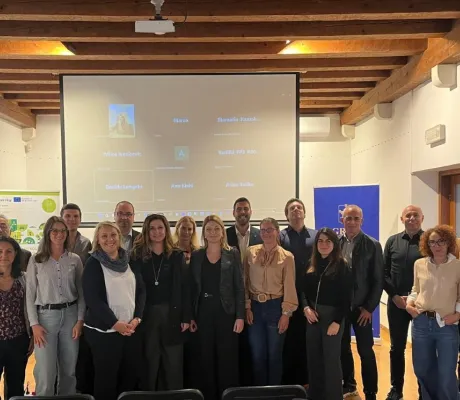
On Wednesday, May 28, 2025, the second local seminar titled “Climate Change in Cities” was held at the International University of Sarajevo (IUS). The seminar was organized within the framework of the NATURED Adrion Project, as part of WP1 activities – Understanding the Interaction Between Climate and Cities.
The project aims to enhance understanding of the impacts of climate change on urban environments by developing sustainable solutions that integrate ecological, social, and economic aspects across the ADRION region, with a particular focus on the development of green cities and climate adaptation. More than 40 participants, mainly from the academic community, attended the seminar.
During the seminar, two main topics were presented by invited speakers:
The first presentation was delivered by Mr. Domagoj Vidaković, an international consultant from the company Energodata, with extensive experience in preparing and implementing EU-, UNDP-, and USAID-funded projects in the fields of energy, regional development, energy efficiency, and climate change. His presentation, titled “The Effects of Climate Change in Cities”, illustrated numerous examples of the negative impacts of climate change around the world, with a particular focus on the Adriatic-Ionian region and Bosnia and Herzegovina. Mr. Vidaković emphasized measures aimed at preventing the adverse effects of climate change in urban areas. He highlighted measurable indicators of climate change consequences observed in cities over the past 15 years through various case studies. One of the key points discussed was the urban heat island effect, along with strategies to mitigate its negative impact.
The second presentation was delivered by Dr. Ismar Alagić, a professor at the IUS Faculty of Engineering and Natural Sciences (FENS) and the NATURED Project Coordinator at IUS. He presented the topic “Standards and Tools for Regulating Green Building.” The presentation addressed global urban green policies, standards, and tools for regulating green construction, including: Green Spec list, Life Cycle Assessment (LCA), the international certification system for energy-efficient and environmentally friendly buildings LEED (Leadership in Energy and Environmental Design), and the International Green Construction Code (IGCC). It also introduced the Cradle to Cradle (C2C) design approach. IGCC combines the world’s most recognized construction and mechanical standards. The presentation covered the C2C certification criteria by MBDC, along with numerous global examples of C2C design in practice.
Dr. Alagić emphasized that real estate market research conducted in recent years shows that LEED-certified buildings can save approximately 20% of total construction costs over their operational lifetime. Even with an initial cost increase of 2%, the investment in this type of construction pays off tenfold. Special attention was given to the integration of 9 Sustainable Development Goals (SDGs) into urban green policies and efforts to prevent excessive pollution in the Sarajevo area.
At the end of the seminar, upcoming seminars were announced, which are expected to ensure the participation of lecturers and attendees from all relevant institutions related to the thematic focus of the NATURED project.