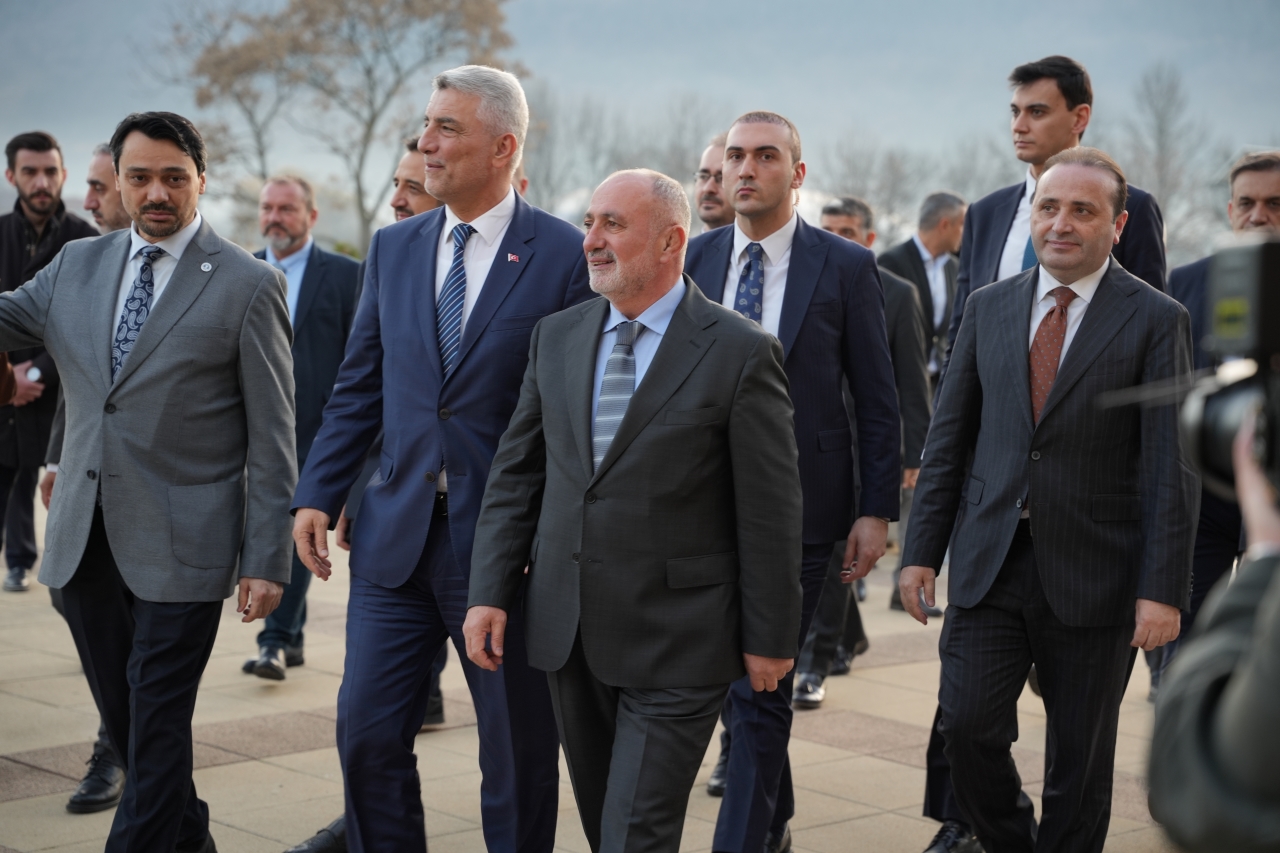
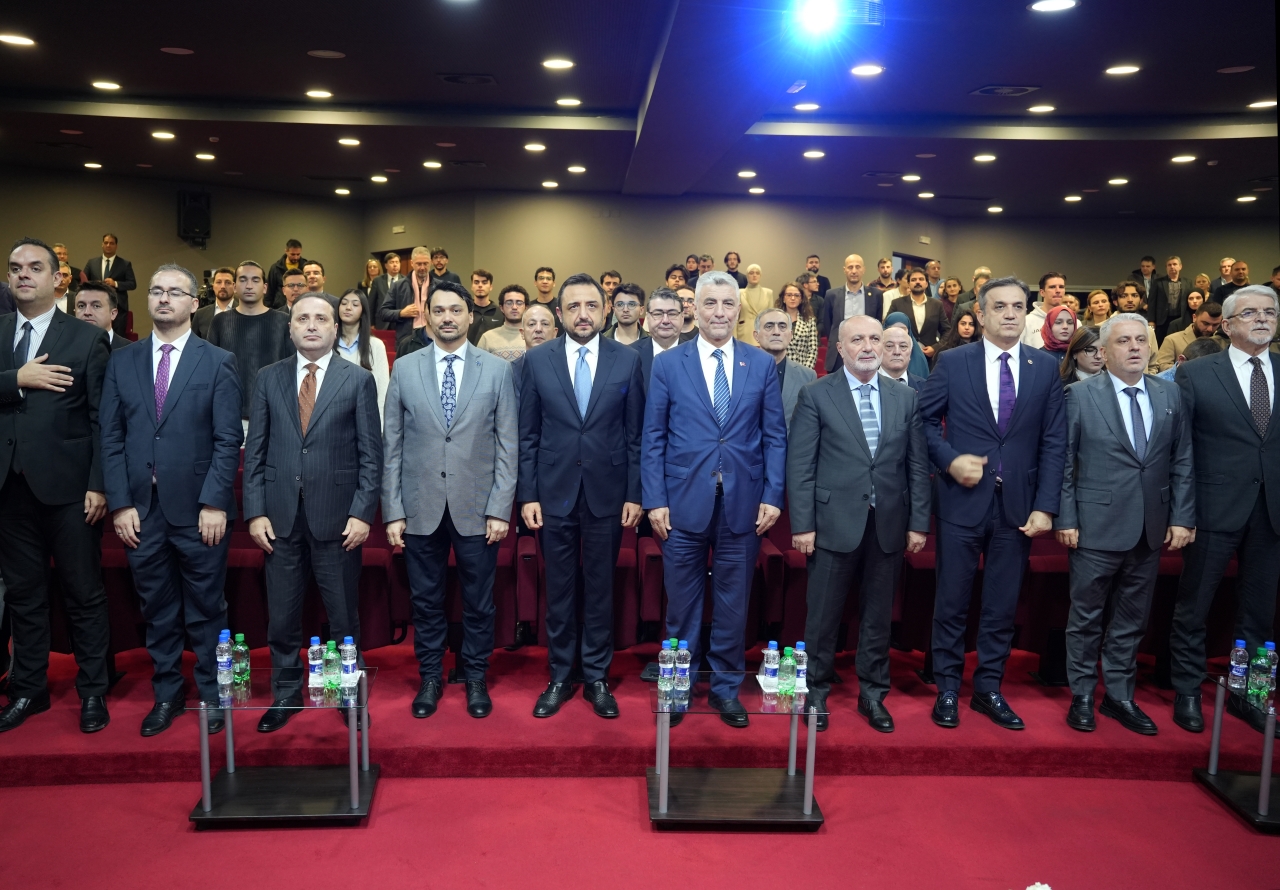
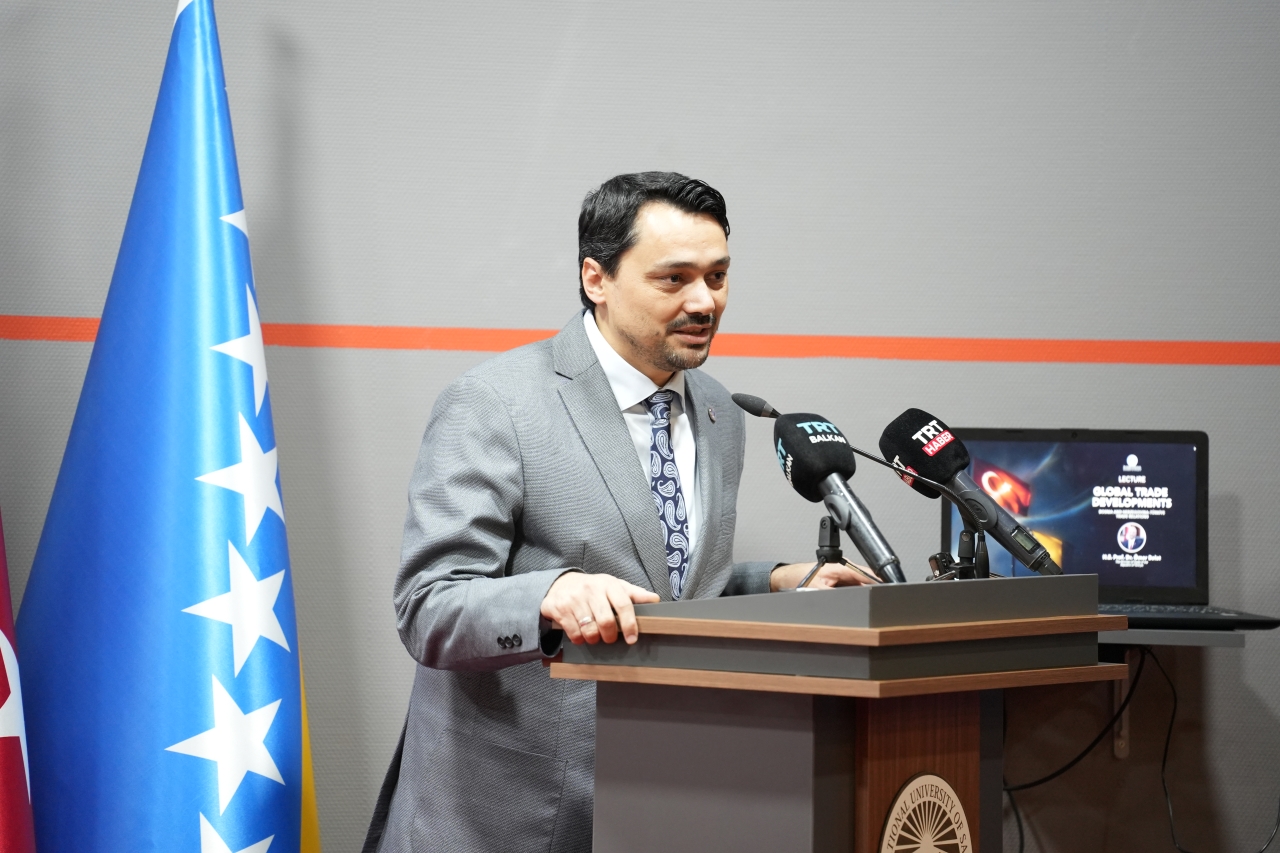
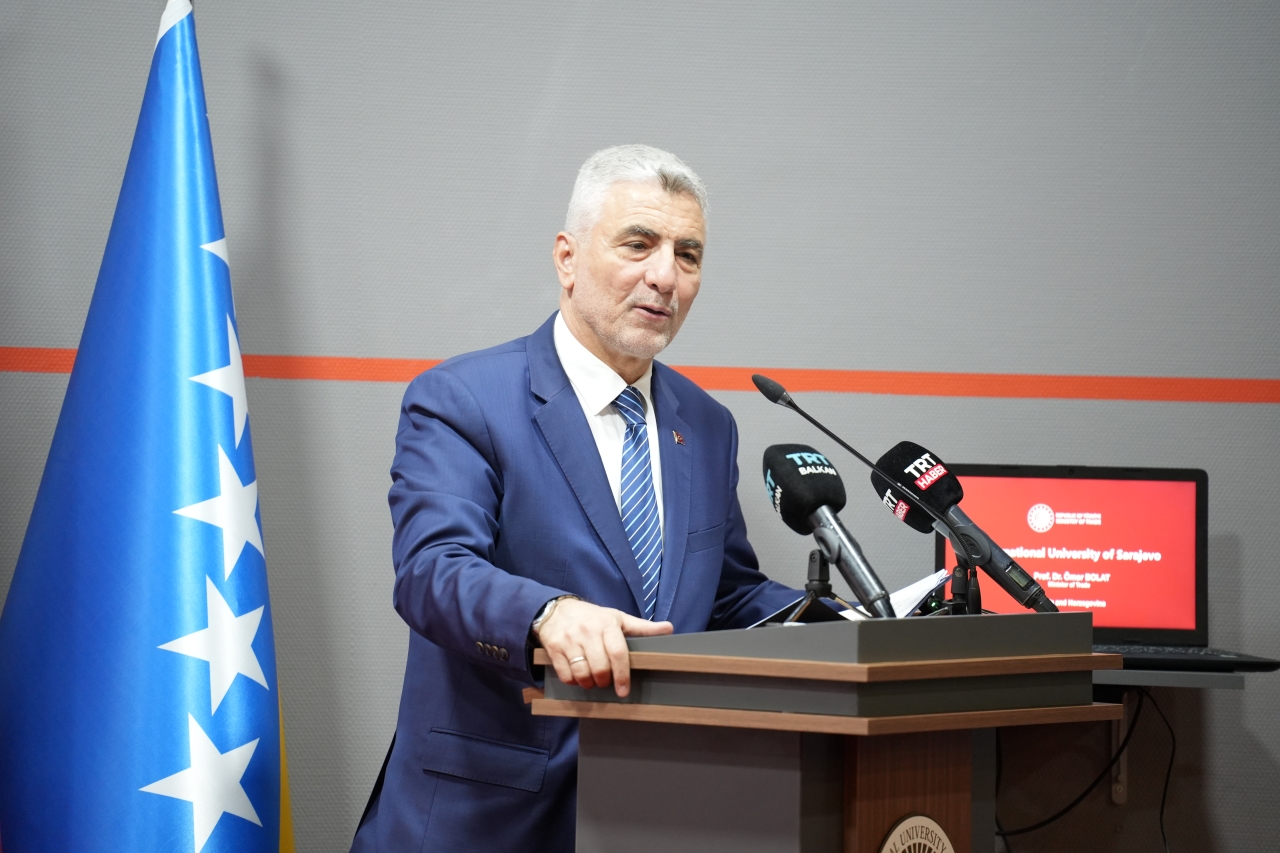
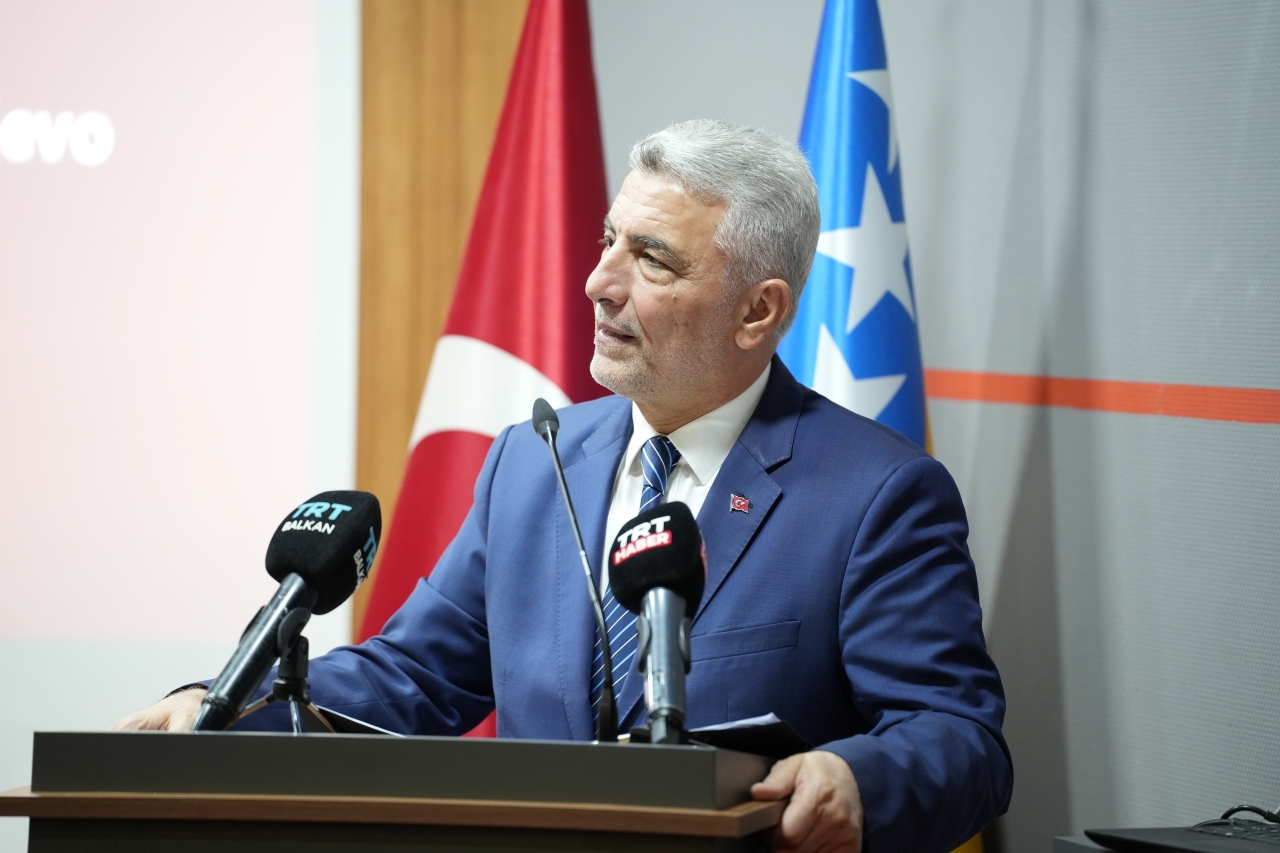
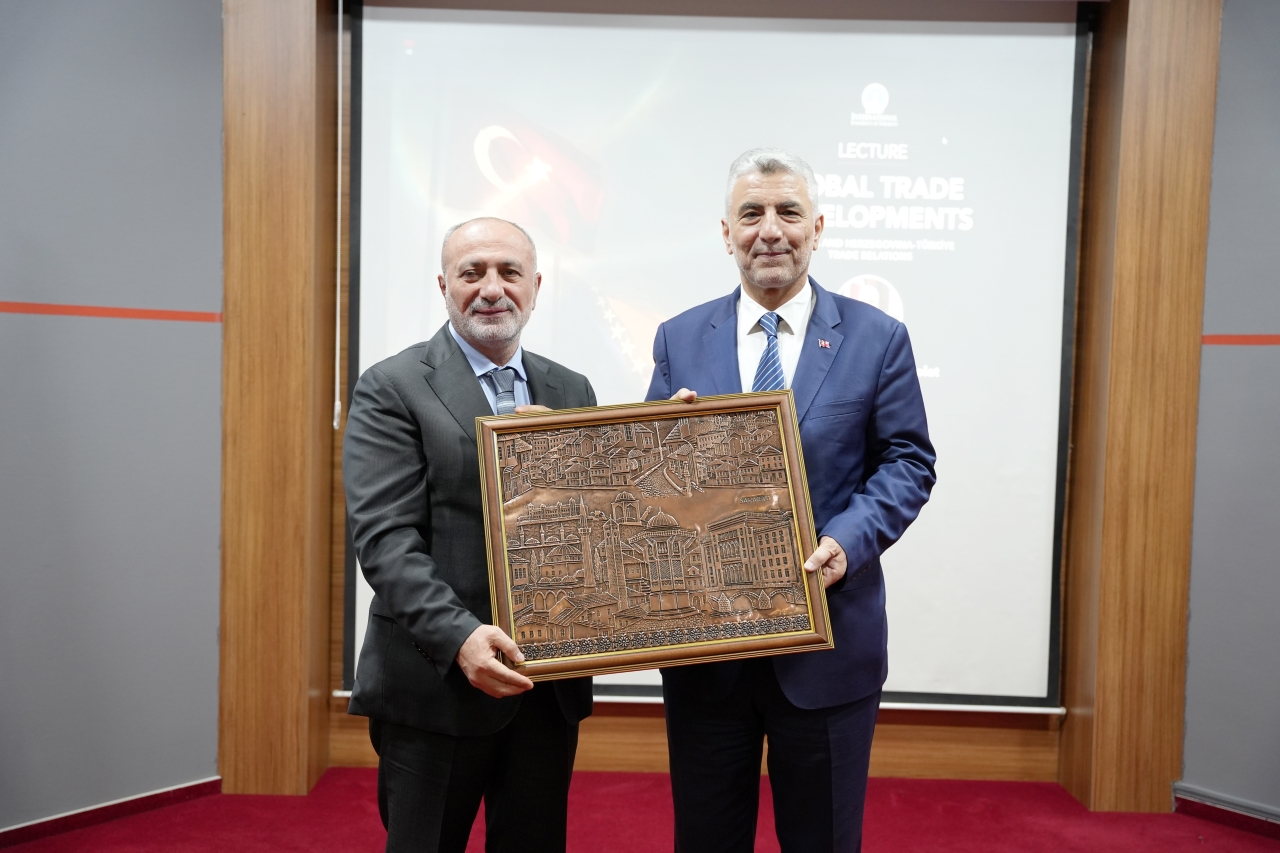
The International University of Sarajevo (IUS) had the distinct honor of welcoming the Minister of Trade of the Republic of Türkiye, Prof. Dr. Ömer Bolat, who visited the University on Thursday, November 13, 2025, to deliver a special lecture titled “Global Trade Developments.” The event brought together representatives of the Governments of Türkiye and Bosnia and Herzegovina, members of the diplomatic corps, business leaders, IUS management, professors, and students.
The program opened with a formal welcome to the distinguished guests, including Minister Bolat; members of the Grand National Assembly of Türkiye; the Ambassador of the Republic of Türkiye to Bosnia and Herzegovina, H.E. Emin Akseki; and the Advisor to the Minister of Foreign Affairs of Bosnia and Herzegovina, Mr. Dino Selimović. Also in attendance were Mr. Hasan Topaloğlu, President of the SEDEF Foundation, and Prof. Dr. Ali Osman Kuşakcı, Rector of the International University of Sarajevo.
In his opening remarks, Rector Kuşakcı thanked Minister Bolat for addressing the IUS community and emphasized the Minister’s significant contributions to the Turkish economy over the past four decades. He highlighted the importance of connecting academic communities with policymakers who play a decisive role in shaping global economic dynamics.
In his lecture, Minister Bolat began by presenting an overview of the global economic outlook, explaining current developments, key parameters, and long-term trends. He noted that global protectionism has reached historically high levels, particularly following recent U.S. tariff measures, which have contributed to a slowdown in global trade. Reflecting on shifts in global output, he pointed out that before the 1990s developed countries dominated the world economy; however, a major transformation occurred as developing nations—especially China and India—became increasingly influential contributors to global production and trade. Their integration into the world economy, he said, significantly accelerated global growth, even though global investment flows have recently shown a downward trend.
Speaking about Türkiye’s economic performance, Minister Bolat highlighted the remarkable progress achieved over the past 22 years. He noted that Türkiye recorded a historic increase in exports of goods, achieving an average annual growth rate of 5.4% between 2020 and 2024. In 2024 alone, Türkiye exported 262 billion USD in goods and 117 billion USD in services. By the end of 2025, Türkiye is expected to become the 11th largest economy in the world by purchasing power. Furthermore, the country has experienced uninterrupted economic growth for 20 consecutive quarters as of the second quarter of 2025. Türkiye currently has free trade agreements with 23 countries, and in 2024 it became the 5th country in the world with the highest services trade surplus. Total foreign direct investment (FDI) inflows increased from 13.5 billion USD before 2001 to 286.2 billion USD between 2002 and 2025.
Addressing economic relations between Türkiye and Bosnia and Herzegovina, Minister Bolat noted that the two countries have benefited from a free trade agreement in force since 2003. Bilateral trade reached 806.2 million USD in 2024, with strong growth expected in the years ahead. More than 200 Turkish companies operate in Bosnia and Herzegovina across various sectors, contributing to employment, production, and trade. Minister Bolat also emphasized that 61 infrastructure projects worth over 2 billion USD—mainly involving motorway and tunnel construction—have been undertaken by Turkish companies in Bosnia and Herzegovina.
In conclusion, Minister Bolat encouraged IUS students to remain innovative, proactive, and engaged, stressing that new generations bring new ideas essential for shaping the future of global trade and international cooperation.