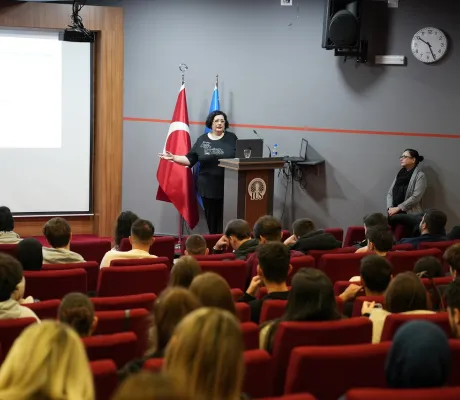
The International University of Sarajevo (IUS) hosted a distinguished lecture titled “Building the New World: Academic and Cultural Bridges for Balkan Youth”, delivered by Mr. Necmeddin Bilal Erdoğan, President of the Board of Trustees of the İlim Yayma Foundation. The event brought together IUS leadership, distinguished guests, faculty members, students, and members of the media for a timely conversation about the responsibility of institutions, intellectual communities, and young people in shaping a more just and humane world.
The main moderation was conducted by Prof. Dr. Ali Osman Kuşakcı, Rector of the International University of Sarajevo, who guided the discussion through key themes - global stability, the role of education and cultural heritage, and the responsibility of youth and intellectual communities in building a better future.
From the opening moments, the lecture set a serious tone: today’s global order is being tested, and many of the frameworks built after the Second World War are increasingly questioned in the face of ongoing wars, humanitarian tragedies, and the visible weakening of international mechanisms meant to protect peace and human dignity.
A conversation shaped by today’s global realities
In a moderated dialogue, Mr. Erdoğan addressed the growing sense of instability across regions—highlighting how war and conflict affect not only the countries directly involved, but also neighboring societies and wider economic and political balances. He emphasized that peace in surrounding regions is not a distant concern, but a direct condition for stability and prosperity - particularly for countries positioned at the crossroads of regions and histories.
In this context, the discussion echoed a well-known principle often voiced in international discourse: “The world is bigger than five.” The conversation pointed to the limitations of current global decision-making structures - especially the imbalance in representation within the UN Security Council, and the consequences of a world in which international law appears increasingly unable to prevent aggression or protect civilians.
Intellectual independence as a foundation for the future
A central theme of the lecture was intellectual independence - not as isolation, but as the confidence to think, research, produce, and lead from one’s own cultural and ethical foundations. Mr. Erdoğan underlined that societies lose their momentum when their intellectual life becomes only an imitation of others, and argued that progress becomes more sustainable when communities reconnect with their identity, heritage, and values - while remaining open to learning and cooperation.
He also spoke about the importance of alternative intellectual traditions and literature, encouraging scholars and students to broaden their references and perspectives—especially in a time when information ecosystems are shaped by power, manipulation, and the rapid spread of misinformation.
Youth, civic engagement, and real responsibility
Drawing from years of civic and educational work with youth, Mr. Erdoğan shared reflections on the character and potential of younger generations: their compassion, sincerity, and strong intention to do good - paired with the modern temptation to reach goals “the easy way.” His message was clear: meaningful growth requires mentorship, patience, and real responsibility.
He stressed that youth development cannot be achieved through slogans alone. Instead, young people must be actively included in decision-making - “by the youth, for the youth” - and supported with guidance, trust, and space to learn from mistakes.
IUS as a bridge - and an investment into people
As a university founded in Sarajevo - a city historically known as a meeting point of cultures - IUS continues to build academic and cultural bridges across the Balkans and beyond, strengthening dialogue, cooperation, and opportunities for young people.
This lecture reflected the values that are close to our hearts at IUS: investment into people is the greatest investment. Education remains the most durable path to dignity, stability, and shared progress - especially for young people whose futures are shaped by forces beyond their control.
The event concluded with appreciation for Mr. Erdoğan’s visit and for the meaningful exchange with the IUS community, reaffirming IUS’s mission to remain a platform where ideas meet responsibility, and where regional youth are encouraged to think independently, act ethically, and lead with purpose.