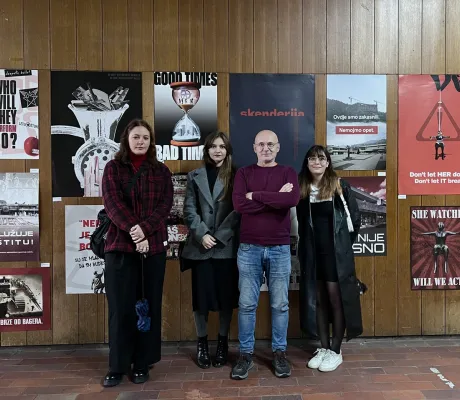
As part of its cultural and academic initiatives, the Art Gallery of the International University of Sarajevo hosted an Artist Talks with Prof. Dr. Amer Bakšić, Full Professor at the Academy of Fine Arts Sarajevo, on the occasion of his solo exhibition currently on display at the University’s Art Gallery.
With this event, the Art Gallery of the International University of Sarajevo officially launched a new talk series entitled Artist Talks, which will accompany future guest exhibitions by renowned local and international artists hosted by the University. The series aims to foster dialogue between artistic practice, critical reflection, and the academic community.
The interview was led by Assistant Prof. Dr. Nadira Puškar-Mustafić, from the IUS English Language and Literature (ELIT) study program, who is also a member of the Art Gallery Committee, actively contributing to the Gallery’s interdisciplinary cultural program.
The exhibition was officially opened on Thursday, December 18, 2025 by Associate Professor Banko Vekić and Full Professor Dr. Meliha Teparić and curated by Dr. Teparić in her role as Director of the IUS Art Gallery and Full Professor at the Visual Arts and Visual Communications Design (VACD) study program.
Exhibition Context
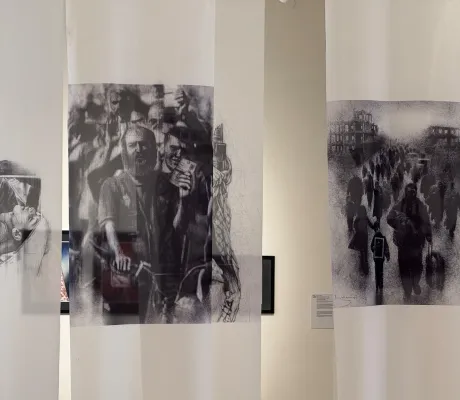
The photographic works presented in this exhibition explore the body as a site of internal movement between thought and emotion. Figures appear blurred, fragmented, and often multiply present within a single frame, emphasizing a state of constant mental and emotional activity. Movement in these works does not function as physical displacement through space, but rather as a visual manifestation of inner processes.
Through extended exposure times and carefully controlled lighting, time itself becomes a visible component of the image, while the body emerges as a process rather than a stable object. The works resist documentary interpretation, instead positioning photography as a self-sufficient medium that does not merely record a state, but actively produces it.
By launching the Artist Talks series, the Art Gallery of the International University of Sarajevo further strengthens its role as a space for meaningful encounters between art, education, and critical dialogue. The conversation with Prof. Dr. Amer Bakšić marks the beginning of a program that will accompany future exhibitions and enrich the cultural life of the University and the wider community.
Artist Talks – The Interview
The Artist Talks interview was structured around a series of questions conceived by Assistant Prof. Dr. Nadira Puškar-Mustafić, framing the discussion around emotion as artistic impulse, the working process, and the specificity of photography as a medium.
Emotion as the Starting Point
Nadira Puškar Mustafić:
I experienced your work as emotion in motion. To what extent do you see emotion as the driving force behind your artistic process?
Amer Bakšić:
I believe emotion is generally the driving force behind everything. Of course, there are people who begin from rational motives, but I think emotion is essential. Without love, dedication, and that sense of magic and desire to realize something, everything loses meaning. Emotion is the initial impulse, and the process unfolds from there.
Personal Experience and Openness to Interpretation
Nadira Puškar Mustafić:
To what extent are the figures in your photographs connected to your personal experience, and where do you intentionally leave space for the viewer’s interpretation?
Amer Bakšić:
The figures are connected to me because I am the model. It was a practical solution, but also a demanding one. As an author, I am very precise, and I could only subject myself to those demands. It was not always comfortable, but it is part of the process.
Process and Repetition
Nadira Puškar Mustafić:
Could you elaborate on the photographic process and the repetition of shots?
Amer Bakšić:
Of course. The images are repeated; we search for a situation that provides visual satisfaction. The process of repetition is crucial, as it establishes the relationship between the body, space, and light.
Movement and Trace
Nadira Puškar Mustafić:
Is it more important for you to capture movement itself or the trace that movement leaves behind?
Amer Bakšić:
The trace is what matters most to me. It is continuous movement - movement that flows. As a visual artist, I find the interpenetration of forms particularly compelling, because later I can read the line, direction, and speed of movement.
Light as a Visual Element
Nadira Puškar Mustafić:
Given your background in drawing and painting, do you think of light as line, gesture, or volume?
Amer Bakšić:
I would not strictly separate those categories. Everything is included. The type of light, its angle, distance, and fall-off are essential. These series were created in different periods and under different lighting conditions.
Space and the Motif of Doors
Nadira Puškar Mustafić:
Doors frequently appear in your photographs. Do they function as purely physical space, or do they also carry psychological meaning?
Amer Bakšić:
The motif of doors has a long history in my work. As early as 2002, I worked on cycles centered on entrance and exit. Here, I return to those earlier motifs, which function both as physical thresholds and psychological spaces.
Series, Fragmentation, and Consistency
Nadira Puškar Mustafić:
How important are repetition and fragmentation in your understanding of the body in these works?
Amer Bakšić:
They are extremely important. A single work can be accidental, but a series clearly communicates intention and direction. Consistency and sustained work on an idea give meaning to the whole.
Why Photography
Nadira Puškar Mustafić:
Although these works could be translated into other media, you chose photography. Why?
Amer Bakšić:
I would not say other media could not express this, but photography surprised me with its strength. I realized that these works are fully sufficient within the medium in which they were created. Translating them into other media remains a possibility for the future.
You can access the full catalogue here: Amer Bakšić - Exhibition Catalogue
You can see the online exhibition here: Amer Bakšić - Online Exhibition