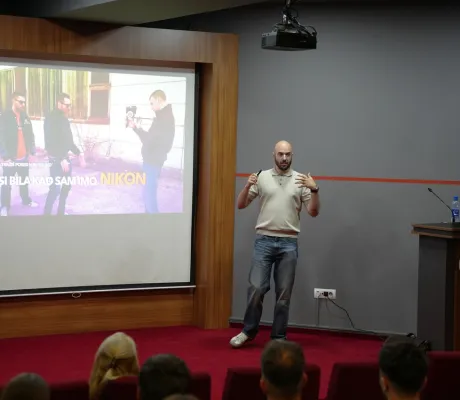
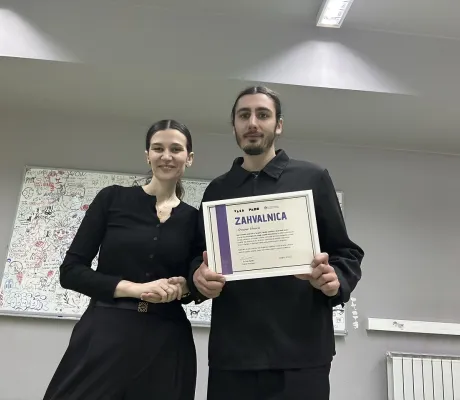
The Faculty of Business and Administration (FBA) hosted a guest lecture focused on the role of digital tools in supporting sustainable development and strengthening participatory governance in the City of Sarajevo. The lecture featured representatives of the City’s Office for Sustainable Development – Ms. Velida Mehić, Mr. Amar Popara, and Ms. Dženisa Abdulai – who introduced students to key digital systems used in their daily work.
The event was organized within the Management of Information Systems course, taught by adjunct instructor Dr. Aida Akagić-Hodžić.
A significant segment of the lecture was dedicated to civic engagement through digital participation. The speakers presented Decidim, an online platform that enables citizens to directly contribute to municipal decision-making under the slogan “Citizens Shaping the City.” They explained how this innovative tool promotes transparency, inclusiveness, and collaboration between local government institutions and the community.
In addition, the guests showcased other digital tools implemented within the City’s administration and demonstrated how these systems support both internal organizational processes and public communication. They highlighted several ongoing projects, including initiatives focused on air quality monitoring and food waste reduction, illustrating how data-driven approaches are increasingly used to address complex urban challenges.
The lecture offered students valuable insight into the practical application of information systems in public administration, particularly in advancing sustainable urban development and citizen participation. It also emphasized the growing importance of digital innovation in creating more efficient, transparent, and responsive cities.
By connecting course concepts with real-world examples from Bosnia and Herzegovina, the session enabled students to better understand how management information systems shape contemporary public-sector decision-making processes.